Summary
At this point, take a step back and celebrate the Evaluation Partnership’s progress. It has been a lot of work up to this point, but, “Well begun is half done” goes the proverb often attributed to Aristotle. Perhaps in this case we are even more than half done. Let’s take a step back and look at where we have come from, where we are, and where we are going.
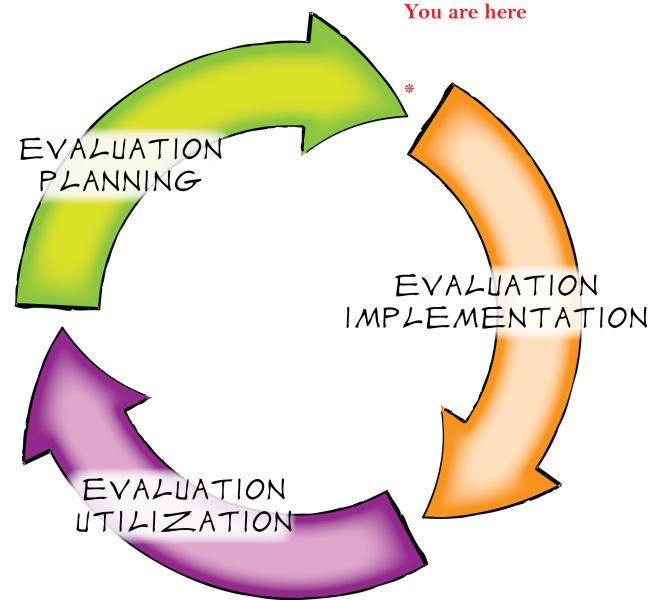
We had suggested that evaluation is ideally viewed as having three stages – planning, implementation, and utilization. With the completion of the evaluation plan, the program has moved through the first stage of the process, and certainly through the most thought-intensive part of the process. In addition, there should be a timeline in place for the implementation and a plan for reporting and utilization, so planning for the entire 3-phase process has been completed. You are now ready to move on to the implementation phase.
A survey of organization directors and program leaders and staff who have gone through this process has shown that participants believed the Evaluation Partnership (EP) process helped them by facilitating clearer thinking about program goals and how program activities connect to those goals, and afforded them a greater understanding of evaluation. Directors responding to an open-ended question on benefits of the EP reported that it increased the organization’s ability to communicate plans and results to funders and other stakeholders.
At this point we hope you, too, agree that the concept of a Systems Evaluation Protocol offers a useful approach to evaluation. You should be more aware of each program as a dynamic and evolving organism, and be cognizant of how these dynamics influence the program’s evaluation needs. A complex nested system of organizations may initially muddle the conception of systems program evaluation, but this approach emphasizes that evaluation can be presented as much more than an end-of-program judgment of the work which comprises the staff’s work life. Evaluation has a role in every phase of program planning and management. Evaluation Partnerships encourage collaboration among individuals with many different perspectives and priorities, and increase everyone’s valuation of each other’s work.