Below the Logic Model is the section for your Evaluation Plan. Click on that header to open the section. There you will see three sections – one for “Purpose Statement”, one for showing or hiding the Evaluation Plan and/or the Worksheet, and finally the Evaluation Lifecycle. Experienced evaluators may simply enter their evaluation plan information in the Evaluation Plan sections provided.
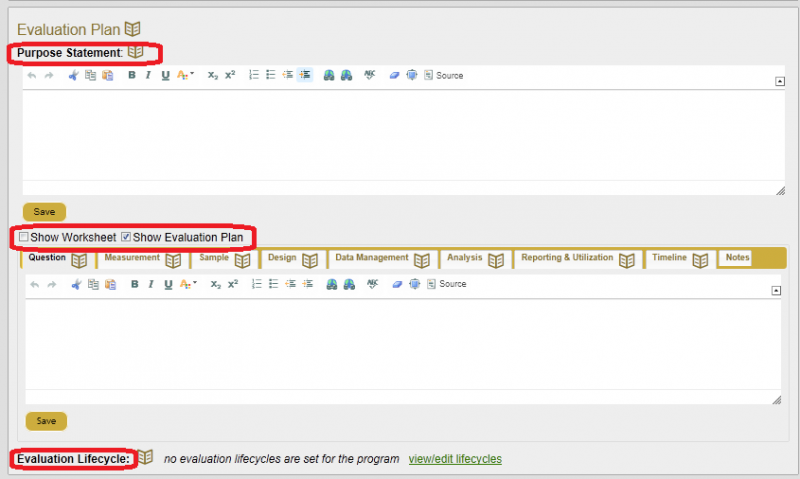
Purpose: In the top box, enter the goals or purpose of your evaluation, click save. (click on the book icon for help on identifying how to create your purpose statement).
Evaluation Plan: Navigate through the sections of the plan by using the tabs for Question, Measurement, Sample, Design, Data Management, Analysis, Reporting & Utilization, Timeline, and Notes. As you enter text for each section, be sure to save it (if you forget, you will be prompted to save when you click off that section). Remember the book icons are there to take you to a help section if you would like resources for planning that section. For more information on how to do an evaluation plan, see the guiding documents in our Evaluation Guidance.
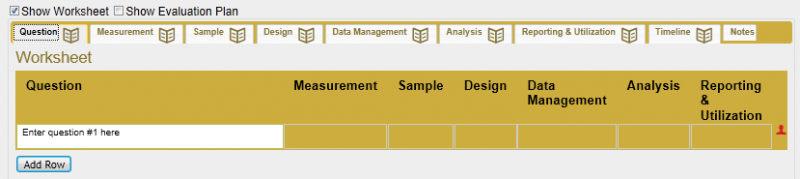
Newer evaluators can click on the box to “show worksheet“. (It may be easier to unselect the “show evaluation plan” option to hide it.) This form allows the evaluator to create a row for each evaluation question (EQ) , then to click through the tabs to build their evaluation plan for each section as it aligns with each question. Once you’ve worked through the SEP steps for creating your evaluation plan, you can summarize the worksheet lines into the the “evaluation plan” sections above. The Worksheet section is for your drafting only, and will not appear in the Evaluation Plan Report. Although you can’t at present transfer data from the worksheet to the Evaluation Plan, you can copy and paste from the worksheet into the plan.
Lifecycles – See the section on lifecycles to identify your program’s evaluation lifecycle, and our tutorial on Documenting Lifecycles.
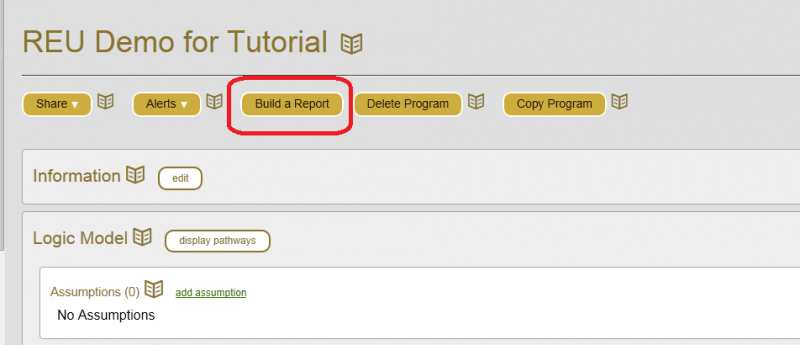
Evaluation Plan Report: When you use the reporting function to print your evaluation plan. There is a link to Build a Report at the top of the Program Page. Note: the Worksheet and the Notes sections will not print in your evaluation plan report. Use these sections to support team communication and documentation about key points.
Q&A
Q: How long should each section of the evaluation plan be?
Each section should be complete, yet concise. The length of a particular section can vary widely based on what that section is and based on the nature of the evaluation plan. Some sections, like Program Mission, are supposed to be very brief. Other sections, like Measurement or Analysis will be longer or shorter depending on the number of evaluation questions, the diversity of approaches used, and (perhaps) the lifecycle stage of the evaluation (later stage evaluations may require lengthier text to explain, though not necessarily). Overall, the goal is to make a plan that is thorough yet concise and is readable and understandable by someone external to your program.
Q: What is the purpose of having a written evaluation plan?
The written plan serves a number of different purposes. First, the process of developing and writing an evaluation plan helps you be more intentional and thorough in your approach to evaluation. In the absence of a formal planning process, it is easy to focus too much on simply finding or creating a measure. Writing out the plan helps you think through and clearly articulate all components (purpose, questions, design, analysis, etc.) of the evaluation, and helps ensure alignment between those various components and the larger needs that this evaluation should serve. In addition, there are benefits to having it as a written document. The written document increases institutional memory, both about the evaluation and about the program itself. The written plan can provide continuity in how evaluation is conducted. Since evaluation is an iterative, evolving process, the plan provides a history upon which future evaluation cycles can be built. Last but not least, the written plan (like the logic and pathway models) is an excellent communication tool for internal and especially external communication. The plan can be included in reports to funders, in applications for funding, or in presentations to legislatures or other important stakeholders. To these audiences, the written plan exemplifies your commitment to and expertise in evaluation.
Q: What should I cover in the Reporting and Utilization section of my evaluation plan?
A first step for crafting this section of the plan is to refer back to the Evaluation Purpose Statement, which should have included a description of how the results of the evaluation will be used. This should help identify the key stakeholders (internal and/or external) who will be most interested in the evaluation results and putting them to use. Think through who those stakeholders are, which part(s) of the evaluation they each care about, and how best to communicate the results to them (format, and so on). This might entail a presentation, a meeting and roundtable discussion, participatory review and analysis, or other ways of engaging stakeholders. Then describe this communication plan in this section. There may also be other stakeholders who would benefit from seeing the evaluation results. Perhaps, for example, the Marketing Team would value seeing results about program outcomes, in addition to the funders who were your primary intended audience? It is also a very good practice to share results back with the individuals or groups who contributed to your evaluation by completing surveys, participating in interviews or focus groups, and so on.
Because each stakeholder or stakeholder group may be interested in different parts and/or may need a different type of report, be sure to reflect these specific needs in this section.
Q: What determines which sampling strategy is most appropriate for my evaluation?
First, be clear about the purpose of your evaluation – who are you interested in learning about and being able to make claims about? This will be your “population of interest.” If it’s a small and easily accessible group, such as current program participants, then you would probably choose to sample that entire group because that’s feasible and provides exactly what you want to know.
However if you are interested in generalizing from the results in your sample group to a larger population, then you will need to be careful about how your sample relates to the population of interest. At a minimum, you might want to gather data about the characteristics of your sample group in order to compare and contrast them to the population of interest. Or you might be engaged in a more challenging evaluation and might need to ensure that your sample is drawn appropriately from the population of interest, so that your claims based on the sample results can legitimately be extended to the population of interest. Random sampling strategies would be appropriate in this case.
In contrast, sometimes you might have reason to deliberately not choose a representative sample. If, for example, your purpose is to examine characteristics of participants who succeeded particularly well in your program, then your sampling strategy would be to identify the high-achievers and obtain data from all or some of them. This would be one example of a non-probability sampling strategy.