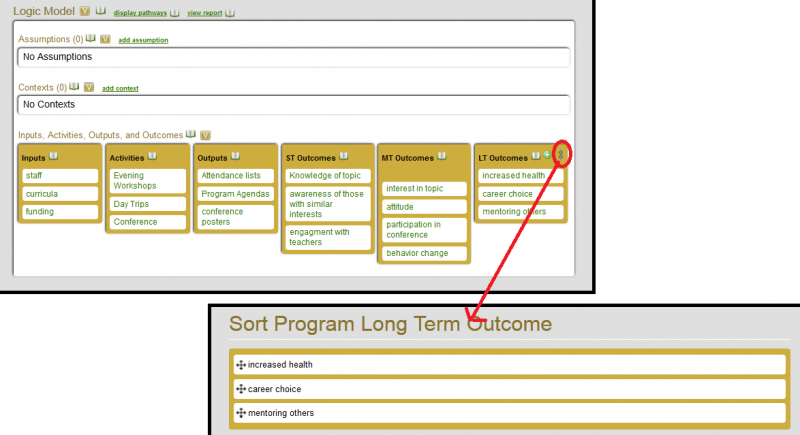
When on the Program page, click on the heading for Logic Model and this section will open. Assumptions, Context, inputs, activities, outputs and outcomes all have links for creating new items.
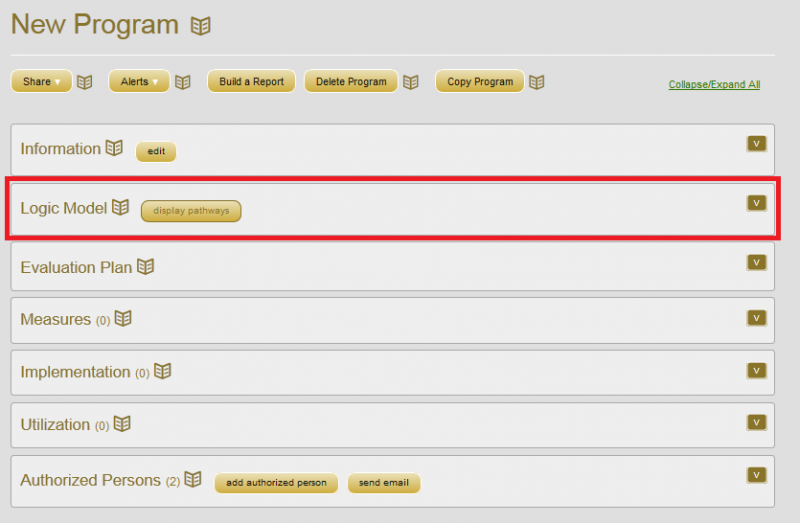
For assistance on completing any section, click on the book icons.
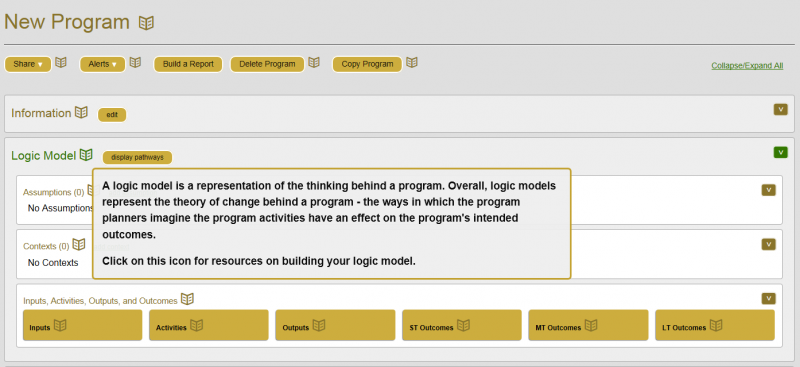
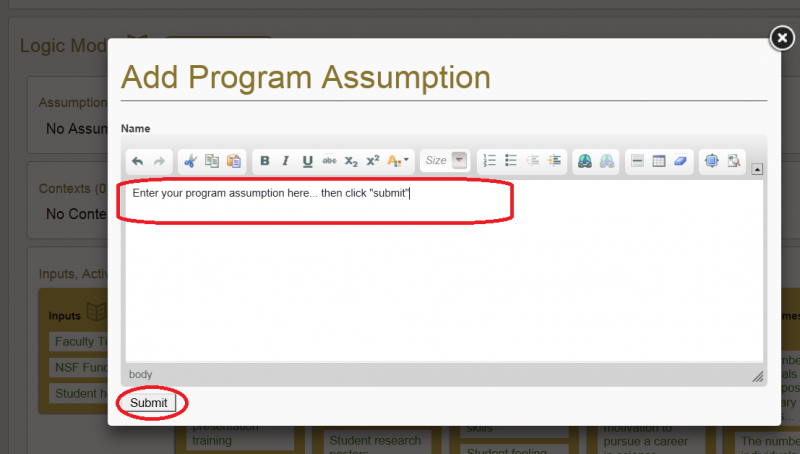
Context and Assumptions – click the “add new ...” to create a new entry.
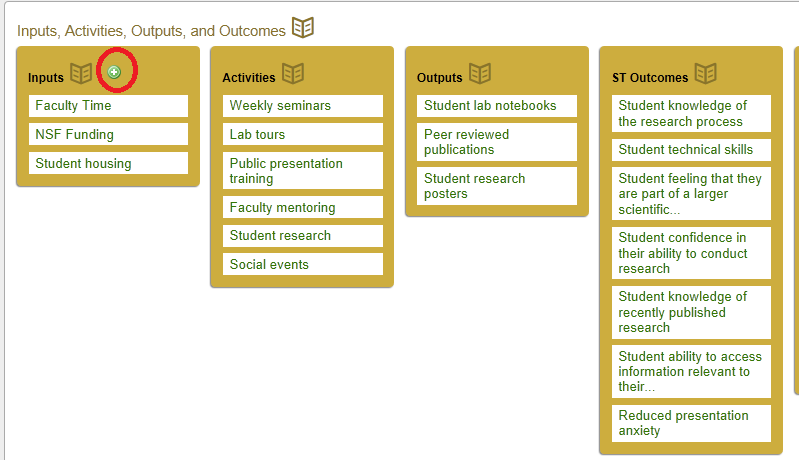
Inputs, Activities, Outputs and Outcomes – In each column hover your mouse over the column heading to reveal the “add” link (a green circle with a +). Click the link, enter the information, and click “save”. (Sometimes the first element doesn’t always show up upon entry, and you may need to refresh your page. Usually using the correct browser will assist. Firefox/Mozilla is strongly recommended, as the Logic model section doesn’t always function properly in Internet Explorer.) Again, be aware you can click on the book icons for help specific to that element.
Sorting: you can sort the order of your activities and outcomes, hover over the column heading, click on “sort”. Click and drag the items into the order you want displayed.
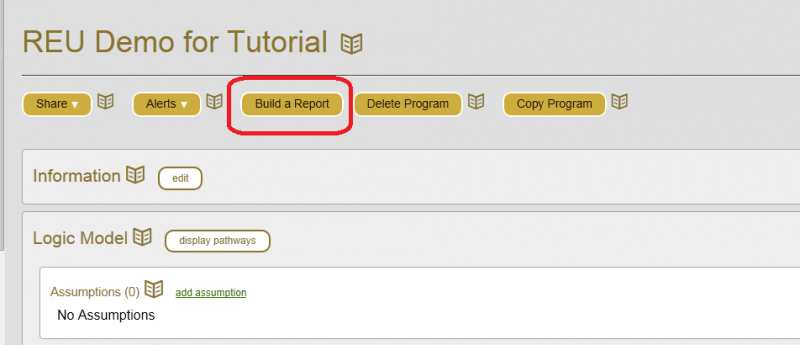
Us the “Build a Report” Link in the Logic Model header line to download a formal copy of your logic model. (See “Creating Program Reports“)
Q&A
Q: How do I delete activities, outcomes, etc.?
In your logic model, double-click on the item you wish to delete – this will open it for editing. In the bottom right corner there is a “delete” button (opposite of the “submit” button”). Sometimes users report that they can’t see those options, and it may be a screen resolution issue. On a PC you can zoom in or out with “Ctrl” and “-“, or “Ctrl” and “+”.
Q: How can I save a Logic Model report as a pdf document?
We usually select the “Print Friendly Page” and then when selecting the printer, we Print to PDF.
Q: Your logic models look different from other versions I've seen. Why is that?
There are several well-established methods/techniques for creating logic models. A columnar format is common to most versions, although there may be differences in the way the columns are labeled. The definition of what constitutes an “output” is probably the element that varies the most across different versions. Other differences sometimes show up in the context and assumption sections as well. Nevertheless, the diverse formats are all attempting to serve the same purpose: to convey succinctly the essential information about what a program entails, why it exists, and what kinds of outcomes are expected to result. The format we provide here allows us to address all the steps in the Protocol, and in particular it is essential for pathway modeling which is unique in articulating the detailed theory of change that underlies a program. Given the common features of most logic models, it is usually not too difficult to adapt a pre-existing one to the format and definitions for use on the Netway with the Protocol.
Q: How do outputs fit in to a pathway model?
Outputs result directly from activities. On a pathway model, arrows between activities and outputs show which activities result in the creation of which outputs. However because outputs are simply artifacts they do not, on their own, lead to outcomes. So there should not be arrows leading from outputs to outcomes.
Q: Should I list every activity separately for the purpose of the logic model?
It depends. Activities that are lumped together can diminish the ability to pose more specific evaluation questions later on. For example, imagine a program that consists of many different workshops with different topics and formats. On the logic model, they are lumped together and labeled simply as “workshops.” The logic model can now no longer show if and how the hands-on workshops have different outcomes than the online workshops, for example. On the other hand, if this same program lists every workshop as a separate activity, there may be diminishing returns. The model will become cluttered and more difficult to read. And, chances are, there will be a lot of repetitive connections to the same outcomes. In order to determine how much to “lump” or “split” activities for the purpose of the program model(s) it is essential to think about their related outcomes. A general guideline is: an activity should be listed separately if it has a unique outcome or set of outcomes compared to other activity(ies).
Q: What is the difference between a logic model and a pathway model?
A logic model is a representation of the main components of a program and the theory of change underlying that program. Both the columnar model and the pathway model are types of logic models. These two types have a lot in common, but each also has unique features. Both models include activities, outputs and outcomes. The columnar logic model also includes inputs, context and assumptions. These components provide important information about what it takes to run this program, what environments it is designed for, etc. This information is useful to others who might want to replicate or learn from this program, and may be important aspects to evaluate. A pathway model does not include inputs, context, or assumptions but it has causal arrows between activities and outcomes, creating a graphical representation that highlights the theory of change in a much more specific and detailed way. These arrows make it possible to see and follow the story-lines that explain how the program seeks to achieve its goals. The graphical representation allows for detailed, shared understanding of what the program is and how it works – this forms an invaluable foundation for making good evaluation decisions.
Q: How do I know if an outcome is short-, mid-, or long-term?
There are no fixed time scale definitions for short- mid- and long-term outcomes. Rather, the general idea is that short-term outcomes arise soon after and as a direct result of an activity. Long-term outcomes describe the ultimate impacts of the program (within the bounds of the program definition). Mid-term outcomes then are the intervening changes that logically connect those immediate effects (short-term outcomes) to the ultimate impacts (long-term outcomes).