For more information on identifying your lifecycles, see the Guiding Documents and the Protocol
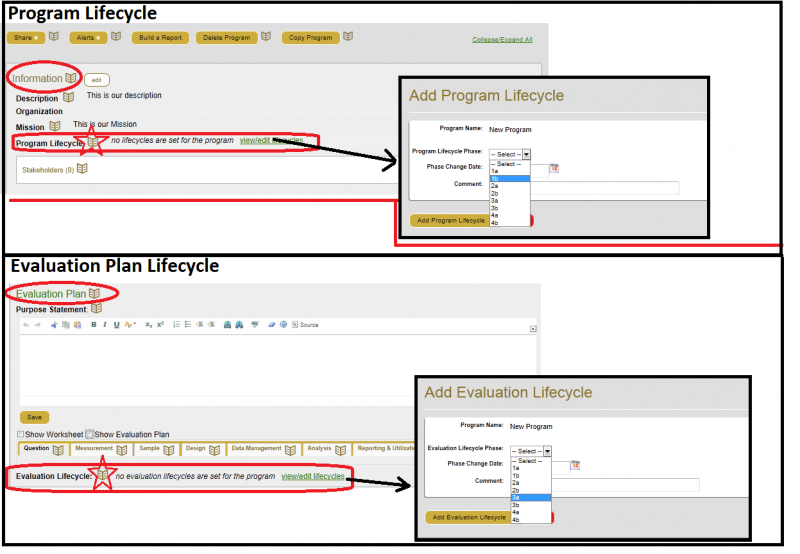
To document your lifecycles: From your program page you can edit your program and evaluation lifecycles.
- Edit your program lifecycle under “Program Information”, and Edit evaluation lifecycle under “Evaluation Plan”. Click on the book icons by the lifecycle heading for resources on identifying your lifecycle, and understanding why it is important. (from this page, the resource is linked to the top right under Guiding Documents.)
When building reports, there is an option to add your lifecycles to your report.
Q&A
Q: Can my program have an early lifecycle phase even if it has been around for a long time?
Yes it can. Program lifecycle phase is not just a matter of the passage of time. The definitions we use have to do with how much a program is changing from one round to the next. So a program that has been around for 30 years but is currently undergoing some big revisions in how it gets delivered or what it covers would be considered an early phase program – it’s in that new phase where you are shifting what works, trying new things, getting the “bugs” out. Similarly, a program that has been around for many years but is “always changing” would be considered a relatively early phase program. This might be the case with a program whose name remains the same, but whose delivery method switches significantly on an on-going basis – this might be a very adaptive program that is constantly changing in response to audience needs or desires. It might be adapting in sensible ways, but by its nature it isn’t settled enough to be considered stable and standardized. Keep in mind that there is nothing inherently good or bad about being in one lifecycle phase or another!
Q: What should I do if my program doesn’t fit well into any of the lifecycle phase definitions?
In practice, the boundary between one phase and the next can be fuzzy and difficult to pin down. The value of this analysis is less about selecting the “right” box, and more about being thoughtful about where your program is in its evolution and where it needs to “go” next. Our general rule of thumb is to choose the lower phase if you really can’t decide where your program belongs. We also recognize that programs have many parts, and sometimes some parts of a program are stable and well-established, while others may be quite new and untried. It is difficult to assign a single lifecycle phase to the whole program in this case, so think in terms of assigning lifecycle phases to the individual parts.