Evaluation Planning – 2.01 Stakeholder Analysis
The goal of this step is to identify all of the potential people and/or organizations that have a stake in the program and its evaluation and to begin to understand their perspectives on the program and its evaluation. This should be a broad and inclusive brainstorming exercise. The working group should be encouraged to name every possible entity at all levels of the system, from program participants to state and national funding sources. Use of a whiteboard or Post-It® notes are suggested so that the stakeholder names can be physically placed and moved on a diagram. The following questions may help guide the conversation:
- Who are the people/types of people who have a stake in the program? Who benefits? Who is responsible for the program? Who takes part in it? Who encounters those who take part in it? Who experiences it indirectly? Whose lives are affected by it? Who has to pay for it? Who has to make decisions about it? Note: Local stakeholders may include the funding agencies, participants, program leaders, parents, administrators, staff, board, local and county government, the press, etc.
- Who else cares about the program, or at least the program’s general scope? This refers to people beyond the immediate scope of the program, and could include the community, schools, policy makers, researchers, a potential future funding agency, other organizations with similar or related programs, global issue leaders, etc.
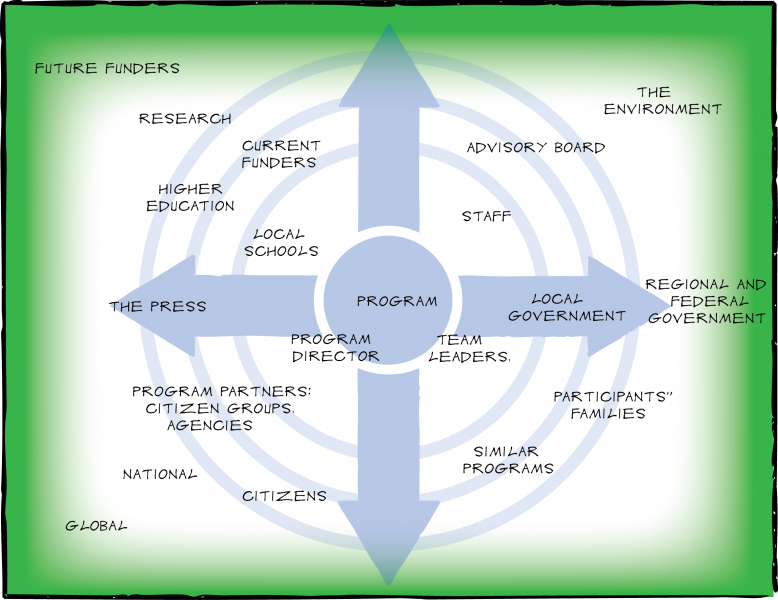
Create a “Map of Stakeholders” – a visual depiction of the stakeholders and their relationship to each other (see Figure 4: Hypothetical Map of Stakeholders). This is an informal map that is designed to show all the key stakeholders or stakeholder groups at a glance. In general the stakeholders most centrally involved with the program should be at the center of the map, and others who are more remotely related should be at the outer circles. You might want to arrange the stakeholders so that similar groups are near each other, but the most important thing is to identify all of the relevant stakeholders and ensure that everyone in the working group is comfortable with the map. There is a blank map in Appendix IV. It is likely you will have to go through several iterations to produce a map that everyone is comfortable with.
Guide the group to consider which aspects of the program each stakeholder is most interested in learning about. It can be helpful for later steps if you record the identified interests of each stakeholder. See the Stakeholder Worksheet in Appendix V.
See also:
Activity: Stakeholder Affinity Diagram
Figure 4: Hypothetical Map of Stakeholders
Q&A
Q: How will my stakeholder analysis affect my evaluation plan?
Identifying and considering stakeholders is important throughout almost every step of the evaluation planning process. Considering the perspective of diverse stakeholders will help you with program definition and boundary issues, with the creation or revision of logic and pathway models, with the selection of the evaluation scope, and with the articulation of the evaluation’s purpose. Explicitly or implicitly, stakeholders will have different ideas about what types of evaluation questions, measurement strategies, evaluation designs, and analysis and reporting plans are credible or useful. For example, a funder might be enamored with experimental or quasi-experimental designs, while program participants are interested in telling their stories, and program implementers want to know if participants enjoyed the program and learned something. Thus, by taking all of these (divergent) perspectives into account, your evaluation plan will more likely be well received by key stakeholders. Going further to actually involve some of them in the evaluation process makes it more likely that the evaluation results will eventually be used; if stakeholders have had no input in and relation to the evaluation plan, they may not see the results as relevant, and might simply ignore them.
Q: How should I go about brainstorming stakeholders?
When brainstorming stakeholders, think about all of the major groups that have or could have an interest in your program. These may include: participants, implementers, funders, partner organizations, community members, tax payers, etc. Once you have brainstormed these larger categories, it may be easier to identify individuals or sub-groups.