2.06 Pathway Model
A Pathway Model is a visual program model closely related to the columnar logic model. A pathway model overlaps with a logic model in that it is based on the activities and outcomes that are in the logic model.Unlike the logic model, it does not include the details of inputs, assumptions, or context. However it adds a significant element by incorporating the logical connections that lead from an activity to one or more short-term outcomes, and from there to medium-term outcomes and ultimately long-term outcomes. It tells the story of how the program works, in a way that can’t be captured in the logic model. Together, the logic model and pathway model present a very informative, concise picture of the program and how it is believed to work.
The pathway model can be developed using the logic model as a basis for articulating clear and direct linkages between program activities and outcomes. If it has not been done already, discussion should help program staff begin to identify key pathways or “through-lines” that connect the activities to outputs and outcomes in their logic model. One way to think of this is to explain:
[ACTIVITY “A”] leads to [SHORT-TERM OUTCOME “X”],
which leads to [MEDIUM-TERM OUTCOME “Y”],
which leads to [LONG-TERM OUTCOME “Z”].
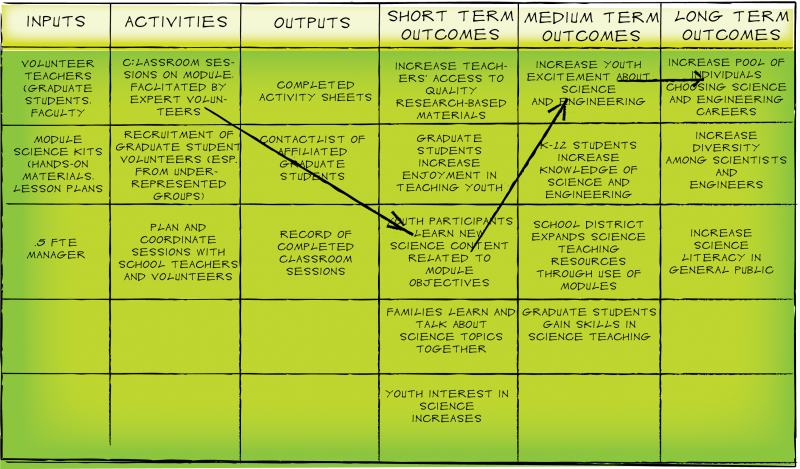
For example, using the sample logic model in Figure 10 shows that program staff may believe that the activity “Classroom session on module, facilitated by expert volunteers” leads to the short-term outcome “Youth participants learn new science content related to module objectives”, the medium-term outcome “Increase youth excitement about science and engineering”, and the long-term outcome “Increase pool of individuals choosing science and engineering careers.”
Figure 10. Sample Path from Activity to Outcome
Using software such as PowerPoint to create a flow chart can assist in presenting a single pathway or a more complete pathway – a single pathway may look something like that in Figure 11 and a more complete pathway model like that in Figure 12.
Figure 11. Pathway from Activity to Outcome

Figure 12. Program Pathway Model
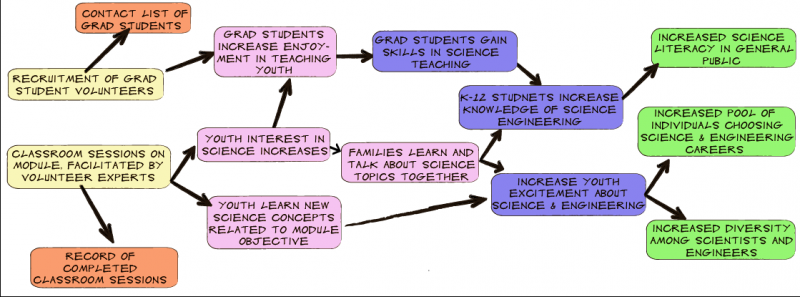
The working group should continue to create these pathway links until “how the program works” has been described to their satisfaction. This is different from a logic model in that it shows how the components of the logic model are connected.
Look at the completed pathway model and ask:
Are there any activities that are not connected to any outcomes?
Are there any outcomes that are not connected to any activities?
If yes, why do these gaps may exist.
Was something simply left out of the model?
Or, is there a program activity that does not really address the program goals?
Is the program expected to lead to a particular outcome, but does not actually include an activity that would result in that outcome?
The items in the completed pathway model should be consistent with the logic model. The connections between activities, short, medium, and long-term outcomes should be relevant, appropriate and logical. In general, short-term outcomes should rarely be connected directly to long-term outcomes. It is also important to check and make sure that there are not any “orphaned” items. This refers to activities that are not connected to any outcomes or outcomes that are not connected to any activities. If you find that either of these situations arises, it is important to revisit the program boundary discussion. In the case of orphaned activities, ask whether the activity is serving an intended purpose or whether, for example, the activity is included because it has always been done. In the case of orphaned outcomes, ask whether there are adequate activities to address the outcome.
It is also important to review the pathways or explanatory “through-lines” that connect specific activities and outcomes. Make sure that the pathways clearly communicate the “story” or “program logic” and do not dead-end at short- or mid-term outcomes, but rather are connected to longer-term outcomes. In general, the pathway model should efficiently communicate the program logic and should be easily readable (e.g., the number of connections should not be excessive).
See Also:
Q&A
Q: What are the benefits of developing a pathway model outside of evaluation planning?
In addition to helping with evaluation planning, developing a pathway model is beneficial for program development and planning. The process of building a pathway model creates a unique opportunity for people to articulate their understanding of the program from their individual perspectives. Almost invariably, this process will lead to ‘Aha!’ moments, in which people come to understand their program in a new light. Another benefit comes from the fact that for many people the pathway model is an excellent communication tool. It offers a quick view of the entire program and helps “tell the story” of how the program works and what it hopes to achieve. The pathway model diagram can be used in accountability reporting and in efforts to secure new funding; and it can hang in your office to show to colleagues (and anyone who walks by) the thoughtful and purposeful design of your program.
Q: If two outcomes reinforce each other, how do I relate them in my pathway model?
There are times when two outcomes mutually reinforce each other. In cases like these, you can have arrows going both ways between the two outcomes in the pathway model. This representation stays true to your perception of how the program works. That particular area of the pathway model could be a good candidate for exploring in the evaluation planning process, exactly because of this interdependence. As you are deciding whether or not to use arrows going both ways, consider the impact on the overall readability and usefulness of the model. Does the importance of displaying that mutual reinforcement outweigh the risk of visual clutter?
Q: In a Pathway model, can I have a short-term outcome lead to another short-term outcome?
Yes you can. In fact, it is often advisable. Doing so will let you present a more detailed and nuanced picture of the underlying process of change for the program. The resulting level of specificity is often necessary for the pathway model to be useful. Thinking ahead to the evaluation effort, since evaluating short-term outcomes is usually more feasible than evaluating more distant mid- or long-term outcomes, it can be advantageous to have early specific changes represented in detail.
Q: How will the pathway diagram be used for evaluation planning?
The pathway model will help guide your evaluation by revealing key outcomes and pathways that may serve as focal points for this evaluation cycle. This focusing is important because it is (usually) not feasible to evaluate the whole program in one year. The visual nature of the pathway model offers a uniquely powerful way to see the key “nodes” in the overall process of change, for example, outcomes that may have many arrows “going in” or “coming out”, or both. (Ironically, although the pathway model is built from the knowledge held by the model-builders, it is sometimes only when they step back and look at the resulting visual display that these patterns can be recognized fully.) These model components become candidates for consideration, along with other factors such as stakeholder priorities, lifecycle considerations, and feasibility, in finalizing the evaluation questions.
A pathway model can also help with what is often a challenge for program staff, namely, that funders or other stakeholders want “evidence” about the program’s impact on long-term outcomes which is simply not feasible for program staff to evaluate. In this case, the pathway model is useful for demonstrating the conceptual linkage between shorter-term outcomes (which can be evaluated) and more distant outcomes. The burden of evaluation is reduced if you can then find published research to support these longer-term conceptual linkages.
Q: How do mid-term outcomes connect to other parts of a logic/pathway model?
The mid-term outcomes tend to answer the “and then what happens?” questions that take you from short-term outcomes out toward the larger and longer-term changes. They fill in the stepping stones of a change process. Mid-term outcomes may capture a deepening of the awareness and knowledge gains, and changes in behavior on the part of the participants. Mid-term outcomes also tend to include spillover effects – changes in the condition of surrounding people (family members, community members, etc.) as an individual participant’s actions and behavior have wider effects.
Q: How do short-term outcomes connect to other parts of a logic/pathway model?
Short-term outcomes are closely connected to activities and either arise directly from an activity or from another short-term outcome. Short-term outcomes may lead to other short-term outcomes, or to mid-term outcomes. (They should not be connected directly to long-term outcomes. If you feel you want to connect a short-term to a long-term, pause and think about what mid-term outcome actually arises in between.)
Q: How do outputs fit in to a pathway model?
Outputs result directly from activities. On a pathway model, arrows between activities and outputs show which activities result in the creation of which outputs. However because outputs are simply artifacts they do not, on their own, lead to outcomes. So there should not be arrows leading from outputs to outcomes.
Q: What is the difference between a logic model and a pathway model?
A logic model is a representation of the main components of a program and the theory of change underlying that program. Both the columnar model and the pathway model are types of logic models. These two types have a lot in common, but each also has unique features. Both models include activities, outputs and outcomes. The columnar logic model also includes inputs, context and assumptions. These components provide important information about what it takes to run this program, what environments it is designed for, etc. This information is useful to others who might want to replicate or learn from this program, and may be important aspects to evaluate. A pathway model does not include inputs, context, or assumptions but it has causal arrows between activities and outcomes, creating a graphical representation that highlights the theory of change in a much more specific and detailed way. These arrows make it possible to see and follow the story-lines that explain how the program seeks to achieve its goals. The graphical representation allows for detailed, shared understanding of what the program is and how it works – this forms an invaluable foundation for making good evaluation decisions.
Q: Why should I include long-term outcomes that I will not be around to see (things that may emerge 20 years from now, for example)?
A logic model is not supposed to just show things you can see or measure. It is meant to convey information and a vision of how the program works. Having a broad and full vision of what your program is about provides valuable information about what motivates the program, who might want to fund it, and what needs it is addressing. The long-term is an important part of that picture. Note also that including long-term, distant outcomes in your model does not imply that you are claiming that your individual program is solely capable of, or responsible for, huge outcomes like community well-being, poverty eradication, scientific breakthroughs, and so on. But you can claim how the program is contributing to broader changes and what you are working toward.
Q: What defines “mid-term” when talking about “mid-term outcomes?”
It’s not useful to fix a calendar time interval for short-, mid- or long-term in logic modeling, because the programs being modeled can be so different. If the program is a one-session workshop lasting 3 hours, then the timeframe for outcomes is likely to be much shorter than it would be for a program with multiple activities that lasts for a semester or a year. “Mid-term” covers those outcomes that occur in between immediate or rapid short-term effects and the ultimate long-term changes that a program is aiming for.