2.05 Logic Model
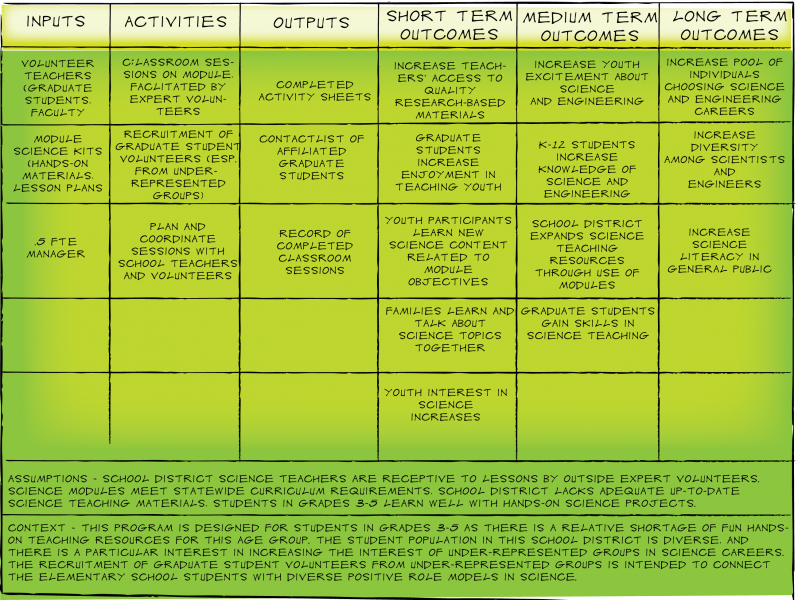
The goal of this step is to help the working group generate an initial logic model that captures the program assumptions, context, inputs, activities, outputs, and short-, medium-, and long-term outcomes. Use the Logic Model Worksheet and Logic Model Definitions and Guidance document for this step. The following is a description of the components of the logic model and an example is shown in Figure 9 (bottom of page). The programs we have worked with have also found it helpful to be aware of the key aspects of a good logic model, and therefore we created a Logic Model Feedback Form .
Inputs
Inputs should include a BRIEF, clear, informative, and complete list of key resources such as staff, curriculum, teaching materials, outside partners and facilities. Often staff inputs are described in fractional “Full Time Equivalent” (FTE) increments. The inputs should give the reader an “at a glance” idea of the program’s size and scale. The list does not need to be lengthy but should describe succinctly the resources needed to implement the program.
Activities
The activities list should be complete and understandable, as it is the basis for the remainder of the Logic Model. Based on the boundary discussion, staff should be able to determine what gets included as an activity. Activities should be well defined so that someone unfamiliar with the program can understand the activity titles. For example, instead of naming an activity “Green Garden” you could use a more descriptive (yet short and succinct) title such as “Green Garden Weekend Workshop” or “Green Garden 1-Day Conference” so that the reader gets a better idea about what is happening. The activity titles should be written so that they can be understood by a general non-specialist reader.
It is sometimes difficult to decide how narrowly or broadly to define an activity. For example: for a program consisting of multiple workshops, should the activity list include each workshop separately, or should they be bundled together into a single activity referring to the combined workshop series? The choice will depend on the nature of the program and on the kind of detail in the rest of the program model. If the individual workshops are expected to have distinct outcomes (one focuses on basic knowledge, one on how to use equipment safely, etc.) and if the resulting short-term outcomes are important to distinguish, then it may be useful to list the individual workshops as separate activities. However if you are working at a higher level of generality, and particularly if the workshops are really interwoven, then it might work better to have the workshop series as a single activity, with more comprehensive, broader outcomes.
The activities list should only include activities that reach people who participate or who are targeted and should be consistent with the program as it is described in the program description. It should typically NOT include administrative, marketing or other activities carried out by program staff. (Recruitment, follow-up and a host of other administrative activities generally do NOT belong in a logic model. However, there are exceptions. For example, it would be legitimate to have “recruitment” in a logic model if the program was working to diversify the organization’s volunteer pool.)
Outputs
Outputs are the by-products of activities. These could include certificates of attendance or completion and objects that were created as part of the program (such as products generated by participants in activities). If something is done by a participant it should be listed in the outputs section. If something is an effect on a participant, then it should be listed in the outcomes section. The outputs should be clearly described and included for activities that are likely to generate outputs.
Outcomes
The difference between short-term, medium-term, and long-term outcomes is a matter of relationship to each other, not just the passage of calendar time. Short-term outcomes are the earliest outcomes directly linked to the activities, medium term outcomes stem from the short-term outcomes and connect to the long-term outcomes, and long-term outcomes are generally the furthest out from the activities.
Outcomes should not be limited to things that can be “measured”. The goal in the logic model is to portray a full picture of the program and what it is expected to lead to, even if some of the outcomes are impossible to measure and even if some (long-term outcomes especially) are expected to emerge long past the time of any evaluations that may be done.
In general, the descriptions of outcomes should be clear, informative, and appropriately reflect the program description. They should be written in a general way (i.e., not context specific) and should be phrased as effects on, or changes in, participants and/or their communities or society.Short-term Outcomes
Short-term outcomes should describe results and effects on participants that are logically connected to activities. These outcomes could include things like changes in awareness, knowledge, attitudes, skills, opinions, aspirations, and motivations. Place outcomes in the short term column at the “first glimmer” of their appearance. For instance, the skills of participants may continue to expand over time, but they should be listed as an outcome during the time frame when generally those skills manifest for the first time. Remember that sometimes there is a chain reaction of short-term outcomes, and that even if one outcome generally arrives before another outcome, they can still both be listed in the short-term column. For instance, a student might learn a skill that leads to an increase in their self-esteem. Even though one came before the other, they may both be considered short-term outcomes.
Medium-term Outcomes
Medium-term outcomes should describe effects on participants that logically connect short-term outcomes with long-term outcomes. They tend to be follow-on effects on participants in the form of deeper or more sustained changes in short-term outcomes, and/or the spread of those effects from individual participants to their families or larger groups. Medium-term outcomes could include new behaviors or changes in behavior, practice, decision-making, policies, social action, awareness, knowledge, attitudes, skills, opinions, aspirations, and motivations.
Long-term Outcomes
Long-term outcomes describe the ultimate effects logically connected to medium-term outcomes. These are generally written as occurring beyond the individual or personal level and are likely to include things like social, economic, civic, or environmental effects. The subject of long-term outcomes is generally “the community” or even broader terms such as “a reduction in HIV/AIDS infection”.
Assumptions
Assumptions are the beliefs and thought patterns about how and why a program is expected to succeed. In order to help identify assumptions, ask staff what things might occur that would prevent the program from achieving its long-term outcomes. Assumptions may include the idea that the program will be funded through the next funding cycle, or that the program will have access to space and other resources that may be provided by partners or funders upon whom they rely, or that the training methodology is appropriate for the intended audience, and so on. The assumptions (and context) sections of logic models are sometimes overlooked, but in fact they provide information that is essential for understanding how and why a program works the way the rest of the logic model suggests that it does.
Context
Context is the environment (including the social, cultural and physical context) in which a program will take place. For example, context could be within an afterschool program, at a farmer’s market, or within the Spanish-speaking community. Context also includes factors that affect the need for the program, or the community history that might make the program particularly relevant. (HINT for both assumptions and context: If these details have been mentioned in the program description they do not need to be repeated at length here. Both of these sections should be brief.)
Figure 9. Sample Logic Model
Q&A
Q: How do I delete activities, outcomes, etc.?
In your logic model, double-click on the item you wish to delete – this will open it for editing. In the bottom right corner there is a “delete” button (opposite of the “submit” button”). Sometimes users report that they can’t see those options, and it may be a screen resolution issue. On a PC you can zoom in or out with “Ctrl” and “-“, or “Ctrl” and “+”.
Q: Should I include activities like recruitment, program marketing, training of instructors, or fundraising in my program model?
These background activities are essential for program implementation. However the question of whether they should be included in your program description (and model) is complicated. In reality, all programs have some kind of administrative effort in the background. The question here is, if you had one minute to describe to someone the essence of your program and how it works, would these be among the activities you would talk about? Most of the time the answer is likely to be “no”. There are exceptions though, which is why there is not a hard and fast rule about this. Sometimes an activity that sounds administrative is actually directly related to achieving certain program outcomes. For example, marketing and participant recruitment are often routine (though important!) efforts. But for a program whose success depends on participation by a very specific demographic mix of participants, perhaps including hard-to-reach individuals, the outreach and recruitment effort becomes central to the program in a distinctive way.
Q: Your logic models look different from other versions I've seen. Why is that?
There are several well-established methods/techniques for creating logic models. A columnar format is common to most versions, although there may be differences in the way the columns are labeled. The definition of what constitutes an “output” is probably the element that varies the most across different versions. Other differences sometimes show up in the context and assumption sections as well. Nevertheless, the diverse formats are all attempting to serve the same purpose: to convey succinctly the essential information about what a program entails, why it exists, and what kinds of outcomes are expected to result. The format we provide here allows us to address all the steps in the Protocol, and in particular it is essential for pathway modeling which is unique in articulating the detailed theory of change that underlies a program. Given the common features of most logic models, it is usually not too difficult to adapt a pre-existing one to the format and definitions for use on the Netway with the Protocol.
Q: How do long-term outcomes connect to other parts of a logic/pathway model?
Long-term outcomes should capture the ultimate goals of a program, either or both in terms of how things would unfold for an individual over a long time span (years, perhaps), or in terms of the cumulative effects on a community or society of having more and more participants with these experiences. Long term outcomes would be ones that mid-terms (or other long-term outcomes) lead to. It is likely also that at least some long-term outcomes would feature in the program description, or possibly in the mission statement, since those ought to provide information about why the program exists and what it is striving for.
Q: How do mid-term outcomes connect to other parts of a logic/pathway model?
The mid-term outcomes tend to answer the “and then what happens?” questions that take you from short-term outcomes out toward the larger and longer-term changes. They fill in the stepping stones of a change process. Mid-term outcomes may capture a deepening of the awareness and knowledge gains, and changes in behavior on the part of the participants. Mid-term outcomes also tend to include spillover effects – changes in the condition of surrounding people (family members, community members, etc.) as an individual participant’s actions and behavior have wider effects.
Q: How do short-term outcomes connect to other parts of a logic/pathway model?
Short-term outcomes are closely connected to activities and either arise directly from an activity or from another short-term outcome. Short-term outcomes may lead to other short-term outcomes, or to mid-term outcomes. (They should not be connected directly to long-term outcomes. If you feel you want to connect a short-term to a long-term, pause and think about what mid-term outcome actually arises in between.)
Q: How do outputs fit in to a pathway model?
Outputs result directly from activities. On a pathway model, arrows between activities and outputs show which activities result in the creation of which outputs. However because outputs are simply artifacts they do not, on their own, lead to outcomes. So there should not be arrows leading from outputs to outcomes.
Q: What is the role of outputs in an evaluation?
Outputs play an important role in evaluation. Because outputs are tangible artifacts of activities, connections between activities and outputs can be fertile ground for evaluation questions related to program implementation. For example, in the case of the model airplane program, one might ask “Did participation in the airplane model building workshop lead to the production of finished model airplanes by our participants?” This is essentially a question about the connection between an activity and an output. Answering this question would provide foundational evidence, typically for an early lifecycle program, about whether a program activity is working the way it is intended to.
Q: Should I list every activity separately for the purpose of the logic model?
It depends. Activities that are lumped together can diminish the ability to pose more specific evaluation questions later on. For example, imagine a program that consists of many different workshops with different topics and formats. On the logic model, they are lumped together and labeled simply as “workshops.” The logic model can now no longer show if and how the hands-on workshops have different outcomes than the online workshops, for example. On the other hand, if this same program lists every workshop as a separate activity, there may be diminishing returns. The model will become cluttered and more difficult to read. And, chances are, there will be a lot of repetitive connections to the same outcomes. In order to determine how much to “lump” or “split” activities for the purpose of the program model(s) it is essential to think about their related outcomes. A general guideline is: an activity should be listed separately if it has a unique outcome or set of outcomes compared to other activity(ies).
Q: What should be included in a list of inputs?
Typically the list includes things like % FTE for staff and/or volunteers, budget, and materials. In addition, there may be other inputs that are important to the “story” of your program such as collaborators, curricula, and so on.
Q: Why is it important to identify the program's context?
Just like program assumptions, context helps fill out the entire story of a program. It gives an outside reader a better understanding of the program, and helps an evaluation planner determine what is appropriate. For example, if the program participants are 3rd to 5th graders, it would be inappropriate to use an evaluation tool that requires a high school reading level. The context section of a logic model helps remind evaluation planners of program realities like this.
Q: Why is it important to identify program assumptions?
Identifying program assumptions is important for several reasons. First, assumptions are an important part of the thinking behind any program. As such, it is important to identify them in order for outsiders to fully understand the program and why it is conducted the way that it is. Second, program assumptions are legitimate and potentially important candidates for evaluation. Providing evidence to support a program assumption helps build the foundation of evidence for the overall logic of the program. Finally, program assumptions can help account for evaluation results. For example if the results appear to be “negative” the explanation may be that one or more of the assumptions are not accurate.
Q: What is the difference between a logic model and a pathway model?
A logic model is a representation of the main components of a program and the theory of change underlying that program. Both the columnar model and the pathway model are types of logic models. These two types have a lot in common, but each also has unique features. Both models include activities, outputs and outcomes. The columnar logic model also includes inputs, context and assumptions. These components provide important information about what it takes to run this program, what environments it is designed for, etc. This information is useful to others who might want to replicate or learn from this program, and may be important aspects to evaluate. A pathway model does not include inputs, context, or assumptions but it has causal arrows between activities and outcomes, creating a graphical representation that highlights the theory of change in a much more specific and detailed way. These arrows make it possible to see and follow the story-lines that explain how the program seeks to achieve its goals. The graphical representation allows for detailed, shared understanding of what the program is and how it works – this forms an invaluable foundation for making good evaluation decisions.
Q: How do I know if an outcome is short-, mid-, or long-term?
There are no fixed time scale definitions for short- mid- and long-term outcomes. Rather, the general idea is that short-term outcomes arise soon after and as a direct result of an activity. Long-term outcomes describe the ultimate impacts of the program (within the bounds of the program definition). Mid-term outcomes then are the intervening changes that logically connect those immediate effects (short-term outcomes) to the ultimate impacts (long-term outcomes).
Q: What is the difference between an output and an outcome?
An output is a tangible by-product of an activity (think artifact), while an outcome is an effect on a participant, the community, or society. In a logic model, outputs should be labeled as simple nouns (“photos of participants”, “finished model airplanes”, “contact list of participants”), whereas outcomes should be understood and written in terms of change (“participants’ knowledge increases”, “farm soil health improves”).
Q: Why should I include long-term outcomes that I will not be around to see (things that may emerge 20 years from now, for example)?
A logic model is not supposed to just show things you can see or measure. It is meant to convey information and a vision of how the program works. Having a broad and full vision of what your program is about provides valuable information about what motivates the program, who might want to fund it, and what needs it is addressing. The long-term is an important part of that picture. Note also that including long-term, distant outcomes in your model does not imply that you are claiming that your individual program is solely capable of, or responsible for, huge outcomes like community well-being, poverty eradication, scientific breakthroughs, and so on. But you can claim how the program is contributing to broader changes and what you are working toward.
Q: What defines “long-term” when talking about “long-term outcomes?”
It’s not useful to fix a calendar time interval for short-, mid- or long-term in logic modeling, because the programs being modeled can be so different. In calendar time, long-term outcomes might occur within a year or two, or within twenty or even many more years depending on the nature and boundaries of the program being modeled.
Q: What defines “mid-term” when talking about “mid-term outcomes?”
It’s not useful to fix a calendar time interval for short-, mid- or long-term in logic modeling, because the programs being modeled can be so different. If the program is a one-session workshop lasting 3 hours, then the timeframe for outcomes is likely to be much shorter than it would be for a program with multiple activities that lasts for a semester or a year. “Mid-term” covers those outcomes that occur in between immediate or rapid short-term effects and the ultimate long-term changes that a program is aiming for.
Q: What defines “short-term” when talking about “short-term outcomes?”
It’s not useful to define a standard time interval for short-, mid- or long-term outcomes in logic modeling, because the programs being modeled can be so different. If the program is a one-session workshop lasting 3 hours, then the timeframe for outcomes is likely to be much shorter than it would be for a program with multiple activities that lasts for a semester or a year. “Short-term” is a relative term in a logic model, referring to outcomes that occur by the end of the program or fairly soon thereafter, and are the initial changes that have to happen and lay a foundation for all subsequent changes.
Q: Should I include an outcome even if I can’t imagine how it could ever be measured?
Yes. The logic model is just that – a model. It is supposed to convey a picture of how your program works and what it is expected to lead to or contribute to. Just because you can’t count up or quantify or measure a particular part of that picture doesn’t mean that it’s not an important part of the picture. Even those ill-defined, intangible outcomes can be an important element of the program and can help an outsider understand the program better.
Q: What’s the difference between an “indicator” and an “outcome”?
An outcome is the change you are expecting or hoping to see as a result of people’s participation in your program. An indicator is how you might be able to tell that the outcome has been achieved. For example, an outcome of a nutrition education program might be “Families increase the variety of vegetables in their diet.” An indicator might be the weekly average number of different vegetables consumed at family mealtimes. Another indicator of that same outcome might be the number of different vegetables observed in the family’s grocery store purchases. The outcome should be about the underlying fundamental change that takes place, and that’s what belongs in the logic model. The indicator for a particular outcome might be many different things, and is best decided a part of the evaluation and measurement strategy.
Q: Should I include numbers in my outcome, like “50 farmers will adopt new crop management practices”?
Including numbers would specify a target for your program (and as such is completely appropriate for grant applications or program descriptions if the funder or audience expects that). However for purpose of wording outcomes in a the logic model, it is important to recognize that the logic model provides the basic logic of how your program works, and outcomes describe the changes you are expecting to see as a result of people’s participation in the program. Stating specific numbers detracts from the articulation of the theory of change, by suggesting that the program is a mechanistic black box that “always” leads to 50 changes. So depending on your program situation, a more appropriate phrasing for this outcome might be “Farmers adopt new crop management practices” (if you are just looking for them to change), or perhaps more specifically “Farmers adopt recommended best management practices for crop rotation” (if you are aiming for them to adopt a specific new practice).